Land Movement Update
The City of Rancho Palos Verdes continues to respond to accelerated movement in the landslide complex that is damaging homes, trails, utilities, and infrastructure.
After the City Council requested Gov. Newsom declare a state of emergency last month, the state clarified that RPV can proceed with emergency measures on an expedited basis under an existing Feb. 4 storm-related emergency declaration.
While the City continues to await news on whether Gov. Newsom will request a federal disaster declaration from President Biden that could make federal assistance available, City staff has been at work planning emergency measures that can be implemented soon.
Trails Update
About 8 miles of trails remain closed in the Portuguese Bend, Abalone Cove, Filiorum, and Forrestal Reserves for public safety due to land movement. Park Rangers continue to monitor trail conditions and fill fissures. Last week, Southern California Edison began work on a project to remove 40 de-energized utility poles from within the Portuguese Bend Reserve because the land movement has made maintenance untenable. Any necessary reserve closures to accommodate this work will be shared via this listserv and on the City website at rpvca.gov/landmovement. Incidentally, this project will help the City reduce wildfire risk. Bringing down power lines that could spark wildfires in the fire-prone Preserve has long been a City goal.
March 19 City Council Meeting
On March 19, the City Council will hear the City geologist’s latest findings and consider installing two new dewatering wells in the landslide complex to remove water that is trapped underground and contributing to movement. One well would be installed near Burma Road at the north end of the landslide complex, and the other would be installed along Palos Verdes Drive South on the south end in the turnout area formerly known as “Gateway Park.” If approved by the Council, a construction contract would be presented at its April 2 meeting and work could begin in May. These dewatering wells, also called hydraugers, are expected to cost about $8 million in total. The Capital Infrastructure Program Fund could be used to initiate work while the City explores grant funding opportunities to help offset or reimburse costs. This could include potential funding from a federal disaster declaration if one is declared.
These dewatering wells are components of the long-term Portuguese Bend Landslide Remediation Project, but are proposed to be urgently installed in response to the state of emergency in the same general location as originally proposed to stabilize the area. City staff has been assured that the installation and placement of these wells will not jeopardize a $23.3 million grant from the Federal Emergency Management Agency (FEMA) for the Portuguese Bend Landslide Remediation Project. While the project was selected by FEMA for its Building Resilient Infrastructure and Communities (BRIC) grant program last summer, funds have been allocated but cannot be awarded until the City completes the grant administration process, which could take 2-3 years. Starting work on these two wells before the rest of the Portuguese Bend Landslide Remediation Project is approved for construction does, however, mean the BRIC grant funds cannot be used for this emergency portion of the project. Besides the FEMA grant, Supervisor Hahn’s Office has pledged $5 million to help the City slow the landslide. The Final Environmental Impact Report (EIR) for the Portuguese Bend Landslide Remediation Project is expected to be released this spring and go before the City Council for certification in May 2024.
Assistance to Geological Hazard Abatement Districts
Also at the March 19 meeting, the City Council will consider exploring ways to provide assistance to the Abalone Cove Landslide Abatement District (ACLAD) and Klondike Canyon Landslide Abatement District (KCLAD). These geological hazard abatement districts (GHADs) are separate government agencies independent from the City that levy assessments on property owners in their boundaries for landslide mitigation, including operating dewatering wells. Assistance from the City could include no-interest loans, grants, and/or in-kind services, such as geology, engineering, and project management. Any assistance would be contingent on the GHADs’ landslide mitigation plans being endorsed by a licensed geotechnical engineering company.
Extending the Local Emergency
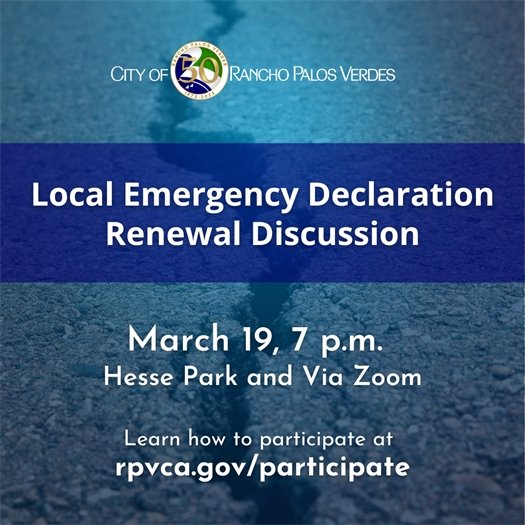
Finally, the Council will consider extending the local emergency declaration that was put in place in October 2023 to bolster the City’s landslide response through May 18. The declaration must be renewed every 60 days to remain in effect.
A staff report (PDF) with more information about this agenda item is available on the City website.

 Share on Facebook
 Share on Twitter
 Share via Email
